


In the rapidly shifting landscape of digital marketing, intuition is a valuable asset, but data is the ultimate compass. As search engine algorithms become more sophisticated—shifting from simple keyword matching to understanding intent, context, and user satisfaction—staying ahead requires a deep dive into the numbers that define the industry.

Search Engine Optimization (SEO) is no longer a “set it and forget it” strategy. It is a continuous process of refinement. To help you navigate this complexity, we have compiled and analyzed the most critical SEO statistics. This guide isn’t just a list of numbers; it’s a strategic roadmap designed to help marketers, business owners, and SEO professionals make informed decisions that drive organic growth.
Table of Contents
The Scale of Search: Why SEO Still Reigns Supreme – SEO Statistics
Before diving into the technicalities, it is essential to understand the sheer scale of the environment we are working in. Google remains the undisputed titan of the internet, but the way users interact with it is changing.
1. The Volume of Opportunity
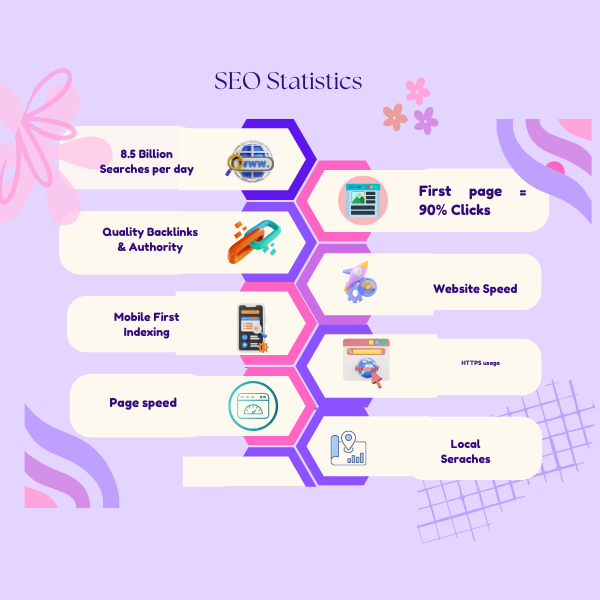
Every second, Google processes over 99,000 search queries. This translates to roughly 8.5 billion searches per day. For businesses, this represents an astronomical number of “moments of intent”—points where a potential customer is actively looking for an answer, a product, or a service.
2. Organic vs. Paid: The Trust Factor
Despite the rise of Google Ads, organic search continues to provide the highest return on investment. Statistics show that organic search drives 53.3% of all website traffic, compared to just 15% for paid search. Furthermore, nearly 70-80% of users ignore paid search results, choosing instead to click on organic listings. This highlights a fundamental truth: users trust search engines to provide the best organic answer over a sponsored one.
3. The Power of the First Page
The “winners take all” nature of SEO is backed by cold, hard data. The first three organic results on a Google search results page (SERP) capture more than 50% of all clicks. If your website sits on page two, you are essentially invisible; less than 1% of searchers click on a result from the second page.

Content Statistics: Quality Over Quantity
The phrase “Content is King” is a cliché for a reason—it’s true. However, the definition of “quality content” has evolved. It is no longer about hitting a keyword density; it is about satisfying the user’s “search journey.”
4. The Length Debate
While short-form content has its place, data consistently shows that long-form content performs better in search. The average word count of a Google first-page result is approximately 1,447 words.
Why does this happen? Longer content allows for:
- Comprehensive Topic Coverage: You are more likely to answer the primary and secondary questions of the user.
- Backlink Potential: In-depth guides are more likely to be cited by other websites.
- Increased Dwell Time: Users spend more time on the page, signaling to Google that the content is valuable.
5. Refreshing Old Content
One of the most overlooked SEO strategies is the optimization of existing content. Research indicates that updating and republishing old blog posts with new content and images can increase organic traffic by as much as 106%. Search engines prioritize “freshness” for many queries, and a simple update can signal that your information is still relevant.
6. The Rise of Video in SERPs
Content is not limited to text. Video is currently the most engaging form of media online. In fact, a website is 53 times more likely to reach the first page of Google if it includes a video. Google’s integration of YouTube snippets and “Key Moments” in search results means that a multi-channel content strategy is now a prerequisite for SEO success.
Backlinks and Authority: The Currency of the Web
Links remain one of the top three ranking factors for Google. They serve as a “vote of confidence” from one site to another.
7. The Correlation of Backlinks to Rankings
The top result on Google typically has 3.8 times more backlinks than positions two through ten. However, it is not just about the number of links; it is about the “referring domains.” Having 100 links from one website is significantly less valuable than having one link from 100 different, high-authority websites.
8. The “No-Link” Reality
A staggering 90.63% of all pages on the internet get zero traffic from Google. The primary reason? A lack of backlinks. Data shows a direct correlation between the number of referring domains and the amount of organic search traffic a page receives.
9. Guest Posting and Outreach
Despite rumors of its demise, guest posting remains a top strategy. Around 60% of write-for-us blogs publish one to five guest posts per month. However, the focus has shifted toward high-relevance niche sites rather than mass-scale link farms.
Technical SEO: The Foundation of Performance
You can have the best content in the world, but if your site is slow or broken, Google will not rank it. Technical SEO ensures that search engine crawlers can easily index your site and that users have a seamless experience.
10. The Need for Speed
Page speed is a confirmed ranking factor. A delay of just one second in mobile load times can impact conversion rates by up to 20%. Furthermore, Google’s Core Web Vitals—a set of metrics that measure loading, interactivity, and visual stability—have become a benchmark for site health.
11. Mobile-First Indexing
We have officially moved past the “mobile-friendly” era into the “mobile-only” mindset. Google now uses the mobile version of a site for indexing and ranking. Since 58.67% of all global website traffic comes from mobile devices, a non-responsive site is an automatic disqualifier for top-tier rankings.
12. HTTPS and Security
Security is a non-negotiable aspect of modern SEO. Over 95% of traffic on Google is encrypted via HTTPS. Sites without an SSL certificate are flagged as “Not Secure” by browsers like Chrome, leading to high bounce rates and a loss of authority.
Local SEO: Capturing the “Near Me” Economy
For small to medium-sized businesses, local SEO is often more important than national rankings.
13. Local Search Intent
46% of all Google searches are seeking local information. Whether it is “plumbers near me” or “best Italian restaurant,” users are looking for immediate, local solutions.
14. The “Map Pack” Advantage
The “Local Pack” (the three businesses shown on the map in search results) is a goldmine. Roughly 42% of users click on results within the Local Pack. Optimizing your Google Business Profile (GBP) with accurate hours, photos, and reviews is the fastest way to capture this traffic.
15. Reviews as a Ranking Factor
Online reviews are the digital equivalent of word-of-mouth. 88% of consumers trust online reviews as much as personal recommendations. Additionally, the frequency and diversity of reviews are known signals that Google uses to determine local authority.
User Behavior and SERP Features
The way users interact with the search page is changing. Zero-click searches are on the rise, and SEOs must adapt.
16. The Rise of Zero-Click Searches
Nearly 25.6% of desktop searches and 17.3% of mobile searches result in zero clicks. This happens when Google provides the answer directly on the SERP via a Featured Snippet or Knowledge Panel. Strategic Insight: Instead of fighting this, aim to be the source of that snippet. This establishes your brand as the ultimate authority on the topic.
17. Voice Search Trends
With the ubiquity of smart speakers and virtual assistants, voice search is skyrocketing. It is estimated that over 50% of consumers use voice search to find local business information daily. Voice queries tend to be longer and more conversational, shifting the focus from “short-tail” keywords to “long-tail” natural language phrases.
Key Industry Trends for the Future
As we look toward the future of SEO, several emerging trends are supported by growing data points.
18. Artificial Intelligence in Search
With the introduction of AI-driven search experiences like Google’s SGE (Search Generative Experience), the way information is synthesized is changing. SEO is moving toward AEO (Answer Engine Optimization). Providing clear, structured data and direct answers will be critical for appearing in AI-generated responses.
19. The Importance of Search Intent
Google’s BERT and MUM updates have made the engine much better at understanding the why behind a search.
- Informational: “How to do SEO”
- Navigational: “Rank Math login”
- Commercial: “Best SEO tools”
- Transactional: “Buy Rank Math Pro” Data shows that pages that align their content structure with the specific intent of the keyword rank significantly higher than those that use a generic approach.
Step-by-Step Strategy: Applying These Statistics
Knowing the numbers is the first step; applying them is where the growth happens. Here is how to turn these statistics into an actionable plan.
Phase 1: The Technical Audit
- Check Load Speeds: Use tools like PageSpeed Insights to ensure your site loads in under 2 seconds.
- Mobile Audit: Ensure every element of your site is clickable and readable on a smartphone.
- Fix 404s: Use a crawler to find and redirect broken links, as they bleed authority.
Phase 2: Content Optimization
- Identify “Low-Hanging Fruit”: Find pages ranking on positions 4–10. Update them with fresh data, better images, and more depth to push them into the top 3.
- Gap Analysis: Look at what your competitors are ranking for that you aren’t. Create comprehensive guides (1,500+ words) to fill those gaps.
- Use Schema Markup: Implement structured data to help Google understand your content and increase your chances of winning a Featured Snippet.
Phase 3: Authority Building
- Niche Outreach: Reach out to industry partners for guest posting or collaboration.
- Digital PR: Create original research or surveys (like this one) that others will want to link to.
- Internal Linking: Don’t forget the power of your own site. Link your high-authority pages to your new content to pass on “link juice.”
Common SEO Myths Debunked by Data
To truly master SEO, you must also know what doesn’t work.
- Myth: Meta Keywords Matter.
- The Reality: Google hasn’t used the meta keywords tag in its ranking algorithm for over a decade. Focus on your Title Tags and Meta Descriptions instead.
- Myth: Social Media Likes are a Direct Ranking Factor.
- The Reality: While social shares can increase visibility and lead to more backlinks, the “likes” themselves do not directly move you up the SERP.
- Myth: SEO is a One-Time Task.
- The Reality: SEO is a marathon. Sites that stop optimizing typically see a 10-30% drop in traffic within six months as competitors overtake them.
Conclusion: The Path Forward
The data is clear: SEO remains the most powerful and sustainable way to grow a digital presence. While the tactics change—moving from keyword stuffing to user experience, from simple links to topical authority—the core principle remains the same: Search engines want to provide the best possible answer to the user.
By focusing on high-quality long-form content, ensuring technical excellence, building genuine authority through links, and optimizing for the local and mobile experience, you aren’t just “gaming an algorithm.” You are building a digital asset that will continue to provide value and revenue for years to come.
SEO is not about chasing the latest “hack.” It is about understanding the data, respecting the user’s intent, and consistently delivering excellence. As the numbers show, the rewards for those who do it right are immense.
Frequently Asked Questions (FAQ)
Q: How long does it take for SEO to show results? A: Generally, it takes 4 to 6 months to start seeing significant results. However, this depends on the competitiveness of your industry and the current health of your website.
Q: Are keywords still important in 2024? A: Yes, but the focus has shifted from “exact match” keywords to “topics and intent.” Google now understands synonyms and related concepts, so your writing should be natural.
Q: How often should I publish new content? A: Consistency is more important than frequency. Whether it is once a week or once a month, maintain a schedule that allows you to produce high-quality, in-depth content rather than rushing out thin posts.
Q: Does bounce rate affect my rankings? A: While Google has stated that bounce rate is not a direct ranking factor, “pogo-sticking” (when a user clicks your site and immediately returns to the search results) is a signal that your content didn’t satisfy their intent.
Q: Is DIY SEO possible for a small business? A: Absolutely. By focusing on local SEO, a Google Business Profile, and answering common customer questions through a blog, a small business can compete effectively in its local market.